
Week 4: What Could My Next Chapter Look Like?
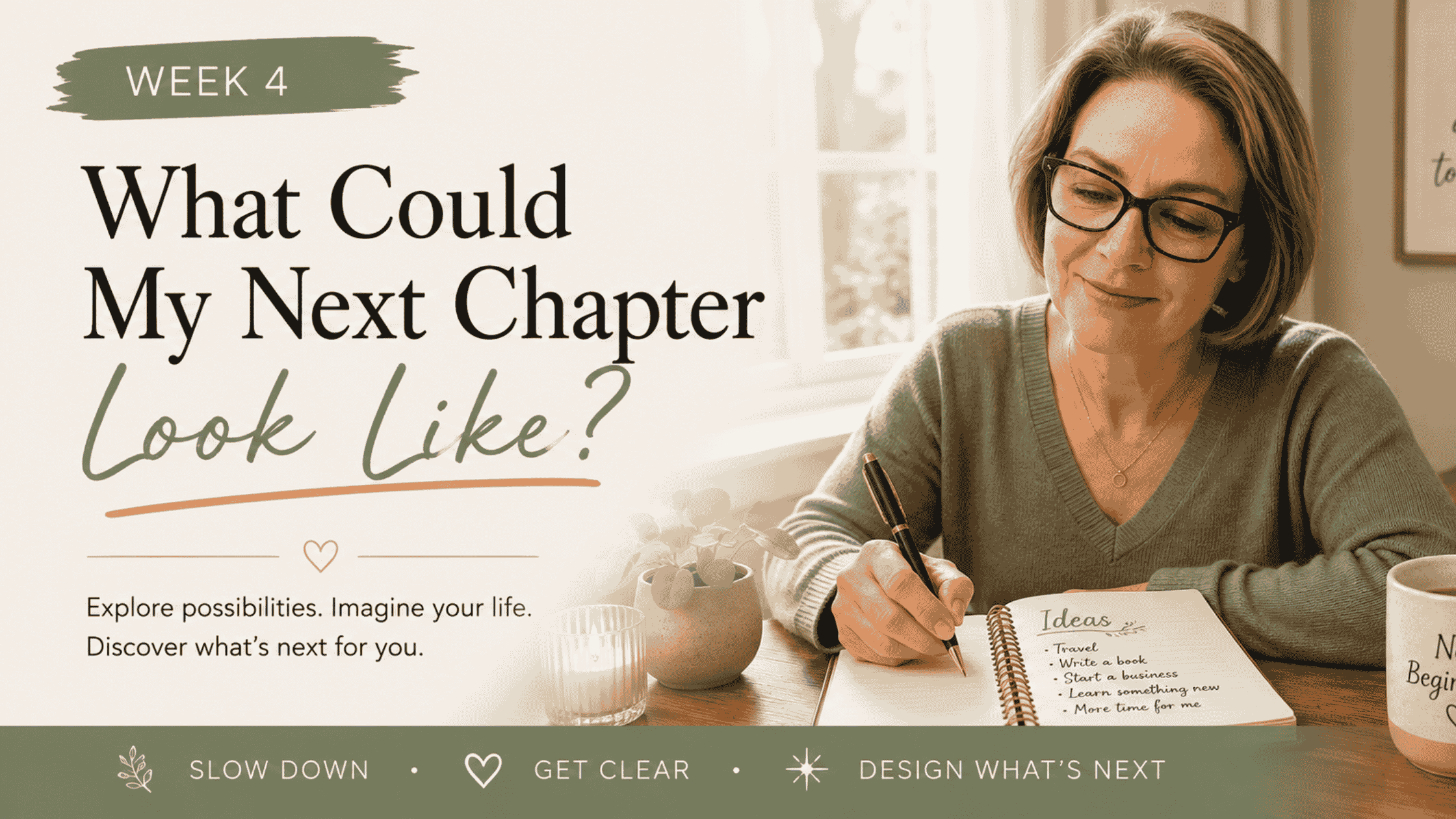
There is a point in midlife when you can recognize that you want something different without having any idea what “different” is supposed to look like.
Maybe nothing is terribly wrong. You have a career you worked hard for, people you love, responsibilities, routines, and a life you have spent years building. You may even be grateful for much of it.
And still, a question keeps surfacing:
What do I want the next part of my life to look like?
That question can feel exciting for about five minutes. Then the practical part of your brain gets involved.
Should I change careers? Start a business? Wait until retirement? Find a hobby? Travel more? Do something meaningful? What would I even be good at? Do I have time for any of this?
Suddenly, imagining your future has turned into another problem you're supposed to solve.
I don't think that's where we should start.
Week 4 of Designing Your Next Chapter isn't about figuring out the answer. It's about giving yourself enough room to discover some possibilities.
And there's a big difference between the two.
Before You Ask What's Next, Look at What You've Learned
If you've been following this series, we've spent the first three weeks looking inward.
In Week 1, you took an honest look at your current season. What is working? What is draining you? What feels finished? What feels unfinished?
In Week 2, you started rediscovering parts of yourself that may have gotten buried underneath work, family, schedules, and responsibilities. You considered your interests, strengths, energy, and the things you're curious about.
In Week 3, you identified the values that matter most to you now.
Those weren't three separate exercises.
They were clues.
Before you start searching the internet for your next career, researching businesses you could start, or deciding that you need an entirely new life, look at what you've already discovered.
What do you consistently want more of?
What are you tired of?
What gives you energy?
What have you missed?
What keeps making you curious?
What matters enough that you want it to be part of the next decade of your life?
Your next chapter doesn't need to come out of nowhere. There is a good chance pieces of it are already showing up in your answers.
Your Next Chapter Doesn't Have to Be About Work
When we talk about reinvention in midlife, the conversation often goes straight to careers.
Quit the corporate job. Start the business. Become a consultant. Turn your passion into income.
Those can absolutely be part of a second act.
But they aren't the only versions.
Maybe you actually like your career, but you don't want it consuming quite so much of your identity anymore.
Maybe what you're craving has nothing to do with earning money.
You might want deeper friendships. More travel. A creative outlet. Better health. A slower schedule. More involvement with your grandchildren. A garden that takes over half the backyard. A cause you care about. Something new to learn.
Or perhaps your next chapter does involve your work, but it isn't about abandoning everything you've built. Maybe it's consulting, mentoring, changing roles, reducing your hours, building something on the side, or finally exploring an idea that's been sitting in the back of your mind for years.
This is why I don't love beginning with the question, "What should I do next?"
"Should" immediately introduces expectations.
Instead, try:
Where am I curious about creating something more?
That question leaves room for an answer you haven't considered yet.
Give Yourself a "Maybe" Season
One of the fastest ways to kill an interesting idea is to demand that it immediately justify itself.
You think, Maybe I'd like to write.
And your brain responds, A book? About what? Who would publish it? Would anyone buy it?
You think, I'd love to travel more.
And suddenly you're calculating vacation days and airfare.
You think, Maybe I could start a business.
And within ten minutes you're worried about health insurance and whether you need an LLC.
We are remarkably efficient at talking ourselves out of ideas we haven't even explored.
So instead of creating a plan, create a Maybe List.
Maybe I could take a class.
Maybe I could start consulting.
Maybe I could learn to kayak.
Maybe I could write.
Maybe I could volunteer.
Maybe I could start a garden.
Maybe I could change jobs.
Maybe I could start something of my own.
Maybe I could travel alone.
Maybe I could spend January somewhere much warmer.
Some ideas can be tiny. Some can be enormous. Some may be completely impractical.
That's okay.
A possibility doesn't need to be practical yet.
You're not signing a contract. You're collecting clues.
Don't Design One Future. Design Three.
Here's where this exercise gets more interesting.
We often imagine that somewhere out there is the "right" next chapter, and our job is to figure out what it is.
That puts an enormous amount of pressure on the decision.
Instead, imagine three completely different versions.
The first is your Practical Evolution.
Most of your current life stays intact, but you deliberately create more room for what you've discovered you want.
Maybe you keep your career but protect Friday afternoons for something creative. Maybe you start traveling four times a year. Maybe you take one class every semester. Maybe you build a small business without any intention of leaving your job yet.
Then imagine your Bigger Change.
What would you consider if you were willing to change something significant?
Maybe you do change careers. Maybe you build a business. Move. Go back to school. Take on a major creative project. Restructure how you work.
Finally, imagine the Wild Card.
What would you consider if you weren't required to explain how it would work yet?
This one can feel uncomfortable because practical women are very good at being practical.
But sometimes the Wild Card reveals what you're actually craving underneath the idea.
Maybe you don't truly want to move to Italy. Maybe you want adventure.
Maybe you don't really want to quit your job tomorrow. Maybe you want autonomy.
Maybe you don't need to become an artist. Maybe you desperately miss creating things.
The idea itself isn't always the answer.
Sometimes it's pointing toward the answer.
Ask Whether an Idea Fits the Woman You're Becoming
Once you have possibilities, you can start evaluating them.
But don't immediately divide them into "realistic" and "unrealistic."
Ask better questions.
Does this excite me?
Does it reflect my values?
Could it fit into my actual life?
Am I interested enough to learn more?
And here's the question I especially want you to consider in midlife:
Does this fit who I am becoming, or who I used to be?
That's an important distinction.
Sometimes we keep chasing goals because they made sense for an earlier version of ourselves.
Maybe the promotion that once represented success doesn't appeal to you anymore.
Maybe you've spent years believing you wanted a huge house and now you're fantasizing about something smaller.
Maybe being needed by everyone once made you feel important, but now you want more independence.
You are allowed to outgrow an old definition of a good life.
Your next chapter should not be designed entirely around what mattered to you at 30.
Forget the Vision Board. Design a Tuesday.
It's easy to create an attractive fantasy about the future.
You're sitting near the ocean. There's coffee. You're working on your laptop for approximately 45 minutes before taking a walk. Somehow you have plenty of money and absolutely no annoying obligations.
That future probably sounds pretty good.
But I want you to imagine something much less glamorous:
A Tuesday.
A completely ordinary Tuesday in the life you'd like to create.
What time do you wake up?
Where are you?
What does your morning feel like?
What kind of work are you doing?
Who do you interact with?
How much control do you have over your schedule?
What happens in the afternoon?
How do you feel at 5 p.m.?
What do you have time for?
What does your evening look like?
This is where vague desires become useful information.
You may say you want "freedom," but what does freedom actually mean?
Maybe it's controlling your mornings.
Maybe it's not answering email after 5.
Maybe it's having the ability to travel without asking permission.
Maybe it's having two hours every morning to write.
Maybe it's being available when your family needs you.
Maybe it's simply not feeling rushed all the time.
You aren't just designing a career.
You're designing the ordinary life you want that career, business, hobby, project, or lifestyle to support.
That distinction matters.
Pay Attention to What Keeps Coming Back
By now, you may have a lot of ideas.
You don't need to choose one.
Instead, notice which ones keep returning.
Which idea makes you lean forward a little?
Which one do you keep thinking about after you've closed the workbook?
Which one makes you want to Google something?
Which possibility would you like to talk to someone about?
Which one makes you nervous but also strangely excited?
Curiosity is useful information.
Choose three possibilities you're interested in exploring further and ask two questions about each:
Why am I drawn to this?
What would I like to know more about?
That's it.
You don't need a business plan.
You don't need a five-year plan.
And you certainly don't need to announce anything.
Your Job This Week Is Not to Decide
At the end of Week 4, I want you to be able to answer one question:
Of everything I've imagined this week, what am I most curious to explore further?
Notice what I'm not asking:
What are you going to do?
We're not there yet.
Right now, we're creating possibilities.
Because before you can design a next chapter that actually fits you, you need to know what you're choosing from.
And once you find something that genuinely excites you, another voice may appear surprisingly quickly.
That's unrealistic.
You don't have enough time.
You're too old to start that.
You don't know enough.
What if it doesn't work?
What will everyone think?
If that voice shows up, don't worry.
That's exactly where we're going next.
In Week 5, we'll look at what's actually holding you back and start separating real obstacles from the fears and assumptions that can keep you standing still.
