
27. How Safe Families for Children Helps Parents in Crisis (And How You Can Get Involved)
If you landed here because you searched for Safe-Families.org, you’re probably trying to understand what it is, how it works, or whether it’s something you could be part of.
I want to walk you through it in a real, practical way. Once I understood what Safe Families for Children does, it was hard to ignore.
What Is Safe Families for Children?
Safe Families for Children exists to keep children out of foster care by supporting parents before things escalate.
Their mission centers around one simple but powerful idea:
Too many isolated parents face crisis situations without a support network.
Instead of waiting until children enter the foster system, Safe Families builds a volunteer-based safety net around families who need temporary support.
It’s often described as “radical hospitality.” That sounds lofty. In real life, it looks like:
A child staying with a host family for a short period
A mom getting a break so she doesn’t burn out
Someone checking in regularly just to say, “You’re doing a good job.”
A church or community stepping in before the state has to
You do not have to be Christian to receive help or volunteer, but many chapters partner closely with local churches.
Why Safe Families Matters
Let’s talk about the part that hit me the hardest.
Imagine you’re a single mom. You don’t have extended family nearby. You get into a car accident. You need surgery. You have two young kids at home.
You have limited options.
In many cases across the U.S., children in situations like that can end up in foster care, even if the parent fully intends to resume custody once they recover.
Here’s what’s difficult:
The median time in foster care is roughly 12–16 months, depending on the state.
Nearly one-third of children in foster care (as of 2022 data summarized by the Casey Foundation) had been in care two years or longer.
Reunification processes can be complex, and the burden often falls heavily on the parent to prove readiness.
State regulations vary widely. Outcomes vary. One thing is consistent:
Family separation carries trauma.
Safe Families steps in before that separation becomes permanent or system-driven.
It is prevention-focused rather than placement-focused.
How Safe Families Works
When you visit Safe-Families.org, you’ll see several ways to get involved.
Here’s what that actually means in practical terms.
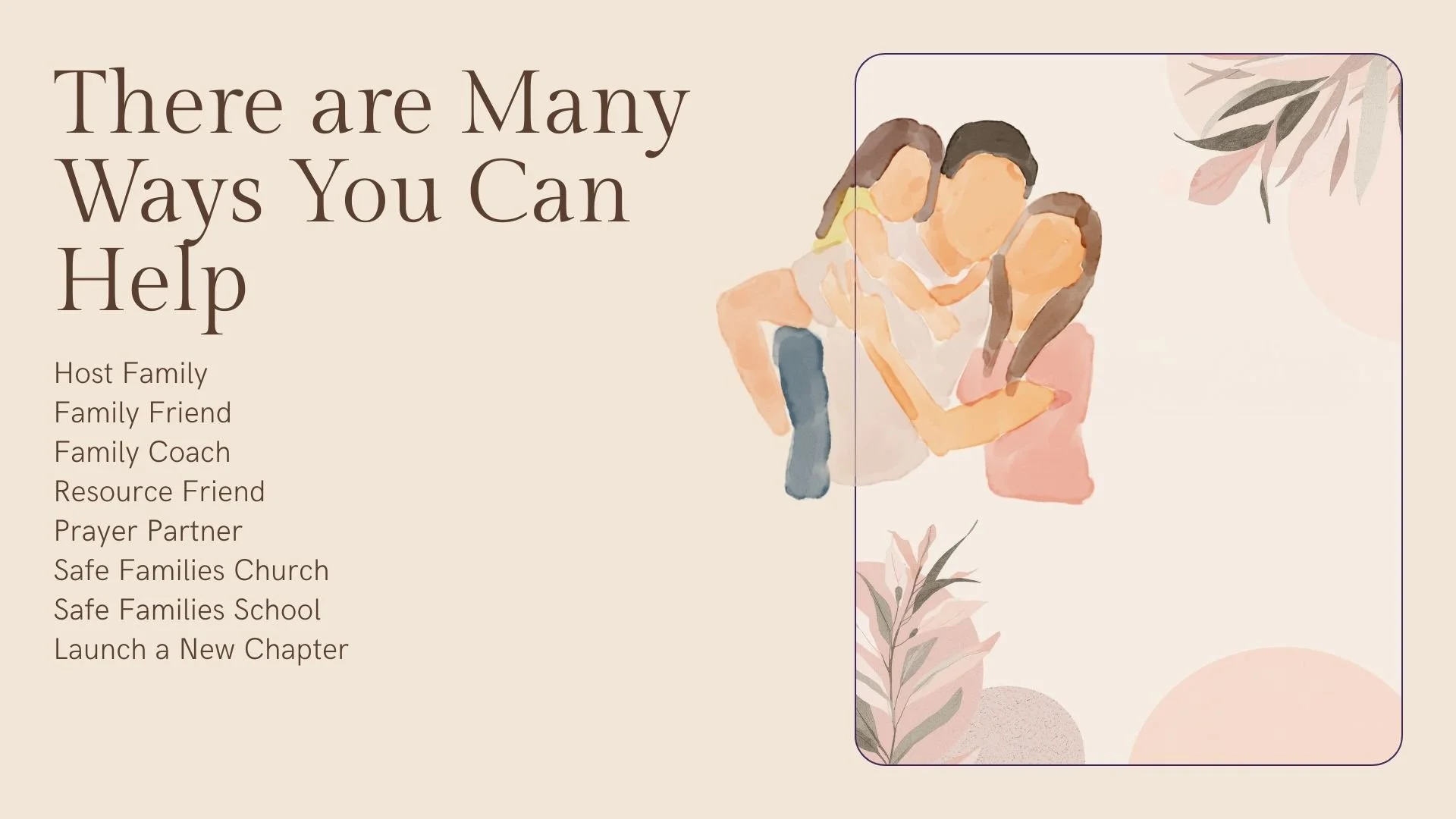
1. Host Family
A host family temporarily welcomes a child into their home.
This is not adoption.
This is not foster care replacement.
It is voluntary, short-term hosting with parental consent.
To become a host family, you go through a screening process that mirrors foster care requirements:
Criminal and child abuse background check (including fingerprinting)
Home inspection
Safety compliance
Training
The onboarding process is the longest part. It requires intentionality.
Once approved, you indicate your availability. In our case:
We both work full-time.
Weekdays don’t work.
We offer occasional weekend support.
We host about once every month or two.
2. Family Friend
This role is often overlooked but incredibly powerful.
A family friend may:
Check in regularly
Offer encouragement
Help connect parents with resources
Provide transportation
Assist with small needs
Sometimes what a mom really needs is someone to say:
“You’re doing better than you think.”
I’ve learned that isolation is heavy. Encouragement is rare. Sometimes the smallest support prevents the biggest collapse.
3. Family Coach
A family coach walks alongside parents more intentionally, offering guidance and accountability when requested.
It’s about partnership.
4. Resource Friend
This could mean:
Donating beds or cribs
Providing diapers
Helping with groceries
Connecting families to local services
You don’t have to bring a child into your home to make an impact.
5. Prayer Partner or Church Partner
Many Safe Families chapters are church-based or church-connected.
There are also partnerships with schools and community organizations.
My Experience With Safe Families (Cleveland Area)
I’m part of a chapter in the Cleveland region.
Here’s what it looks like in real life:
I host one child periodically.
I maintain ongoing contact with the mother.
I check in mostly through text.
I offer advice only if she asks.
I remind her she’s doing a good job.
She is the sole provider for her children and doesn’t get downtime. She doesn’t have extended family support.
Sometimes she just needs a break.
When I think back to raising four kids, there were moments I should have had a break, too.
The difference? I had a network.
She doesn’t.
That’s what Safe Families addresses.
Is Safe Families the Same as Foster Care?
No.
Safe Families is voluntary and preventative.
Parents retain custody.
Hosting is temporary.
The goal is reunification and stability, not system entry.
What It Takes to Get Started
If you’re considering becoming a host family, here’s what to expect:
Background checks and fingerprinting
Home safety inspection
Training sessions
Ongoing communication with chapter leadership
It’s thorough. It should be, but it’s also doable.
You choose your availability and define your boundaries. You aren’t signing up for 24/7 indefinite care.
Why I Chose Safe Families
When Podcast-A-Thon invited podcasters to highlight a charity, I didn’t hesitate.
Podcasthon gives creators a platform to spotlight organizations making a difference.
For me, Safe Families stood out because:
It focuses on prevention.
It supports parents instead of punishing the crisis.
It builds community instead of bureaucracy.
It keeps children out of long-term involvement in the system whenever possible.
As a woman in midlife who has raised kids, I know this:
We all need help at some point.
The difference between thriving and unraveling is often just one supportive relationship.
How to Get Involved With Safe-Families.org
If you’re curious, start here:
Visit Safe-Families.org and look for a chapter near you.
You can:
Explore hosting
Volunteer as a family friend
Donate resources
Start a chapter in your church or community
Attend training
Simply learn more
You don’t have to commit immediately.
Just start by understanding the model.
Final Thoughts
There are many debates about foster care in the United States. Policies vary by state. Funding structures are complex. The system is layered. At the heart of it, there are isolated parents trying to survive hard seasons.
Safe Families offers a simple alternative:
Community before crisis.
Support before separation.
Relationship before regulation.
If you’ve ever thought, “I wish someone would just step in before things fall apart,” this is that model.
Sometimes stepping in looks less dramatic than we imagine.
Sometimes it’s just one weekend.
One check-in text.
One extra set of hands.
That’s enough to change the direction of a family’s story.
